

A fruit ingredient specification sheet can contain a lot of information in a relatively small amount of space.
Depending on the product, it may include details about ingredients, Brix, pH, acidity, color, flavor, microbiological limits, packaging, storage, shelf life, and more. For someone who does not review specifications regularly, it may not be immediately clear which details matter most or how they relate to the finished application.
The specification sheet is an important part of evaluating a fruit ingredient, but it should not be reviewed in isolation. A product may meet its written specification and still not be the right choice for every formulation. Color, flavor, texture, processing conditions, packaging, and commercial availability all need to be considered as part of the larger picture.
Here are 10 important areas to review when reading a fruit ingredient specification sheet.
1. Product Name and Description
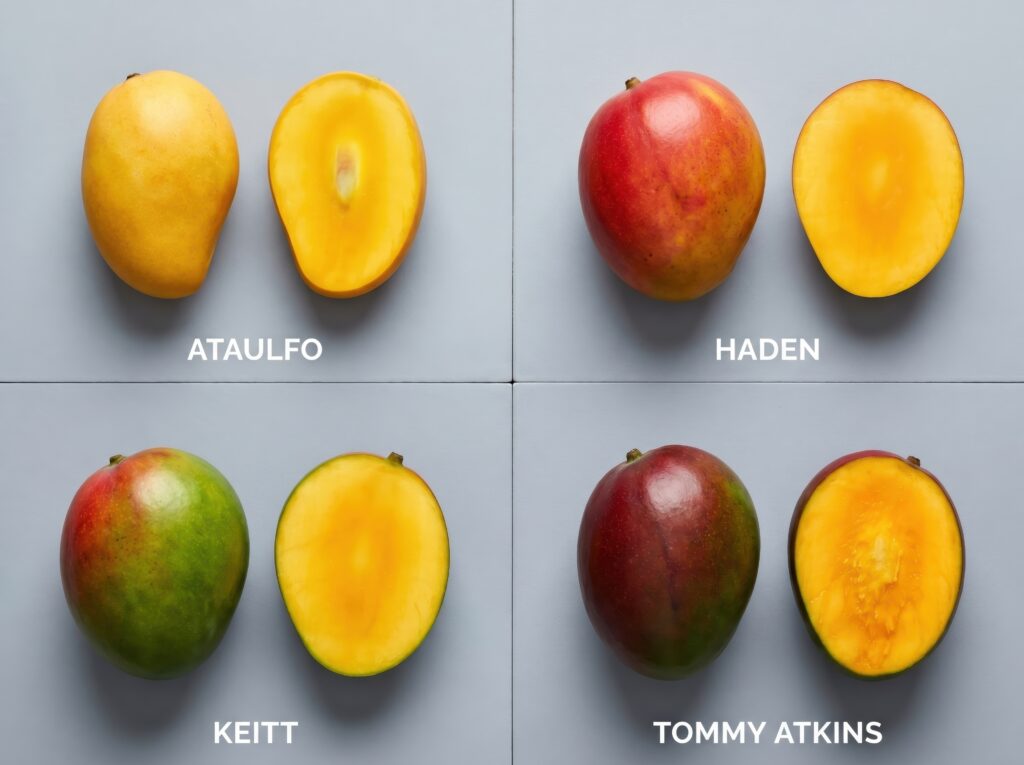
Product descriptions may identify the fruit variety, format, concentration, processing method, or other characteristics that distinguish one ingredient from another.
Start with the product name and description at the top of the document.
This may sound obvious, but small differences in wording can identify substantially different products. Mango puree, mango puree concentrate, mango juice concentrate, and clarified mango juice concentrate are not interchangeable descriptions.
The product name may also identify whether the ingredient is:
- Single strength or concentrated
- Clarified or pulpy
- Aseptic or frozen
- Conventional or organic
- Sweetened or unsweetened
- Made from a particular variety or origin
Some suppliers also assign an internal product or specification number. This number can be helpful when comparing samples, quotes, purchase orders, and technical documents. Two products with similar names may have different item numbers because they have different Brix levels, packaging, origins, or processing methods.
Always confirm that the specification being reviewed matches the exact product being quoted or sampled!
2. Ingredient Statement
The ingredient statement explains what is actually in the product.
A fruit ingredient may consist entirely of the named fruit, but that should not be assumed. Depending on the product and processing method, it may also contain water, sugar, acid, antioxidants, preservatives, processing aids, or other permitted ingredients.
For example, ascorbic acid may be used to help protect color, while citric acid may be used to adjust acidity. A sweetened fruit preparation will have a very different composition and functionality than an unsweetened single-strength puree.
The ingredient statement should be reviewed for:
- Added sugars
- Added water
- Acids or acidity regulators
- Antioxidants
- Preservatives
- Colors or flavors
- Stabilizers or thickeners
- Any ingredient that may affect labeling or the finished formulation
This is especially important when a customer is looking for a clean-label product or has restrictions on added ingredients.
The specification may also note whether the product is free from genetically modified ingredients, allergens, preservatives, or other materials. Supporting statements or certificates may be available separately rather than appearing directly on the specification sheet.
3. Brix or Soluble Solids
Brix is one of the most common measurements found on a fruit ingredient specification sheet.
A refractometer measures the refractive index of a sample and reports a value commonly expressed in degrees Brix. In a pure sucrose solution, one degree Brix corresponds to approximately one gram of sucrose per 100 grams of solution. Fruit ingredients are more complex, so the reading represents soluble solids rather than sugar alone.
Those soluble solids can include naturally occurring sugars, acids, minerals, and other dissolved components.
Brix can help confirm the concentration and general identity of a product. A single-strength juice or puree will normally have a much lower Brix than a concentrate made from the same fruit.
However, a higher Brix does not automatically mean that one ingredient is better, sweeter, or more flavorful than another. Brix should be considered alongside acidity, fruit type, ingredient format, processing method, and intended use.
Specifications often show Brix as a range rather than a single number. This allows for some natural and processing-related variation while establishing acceptable limits for the finished ingredient.
If a concentrate will be reconstituted, the target single-strength Brix and recommended dilution should also be confirmed.
4. pH and Titratable Acidity

pH and titratable acidity measure different aspects of acidity and can influence flavor, processing, stability, and ingredient performance.
pH and titratable acidity are related, but they do not measure the same thing.
pH measures the intensity of acidity, based on the concentration of hydrogen ions in the product. It can affect microbial stability, processing requirements, ingredient interactions, and the performance of the fruit ingredient in the finished application.
Titratable acidity estimates the total amount of acid that can be neutralized and is often expressed as a percentage or as grams of a specified acid per unit of product. Depending on the fruit, acidity may be reported as citric acid, malic acid, tartaric acid, or another predominant acid.
Both measurements can influence flavor, but neither tells the complete sensory story by itself.
Two products with similar pH values can have different titratable acidity, and therefore different perceived tartness or buffering behavior. Likewise, the balance between Brix and acidity can have a major effect on whether a fruit tastes bright, tart, mild, or sweet.
When comparing products, make sure the acidity values are expressed on the same basis. A value reported as citric acid equivalent should not automatically be compared directly with one reported as malic acid equivalent.
For applications in which acidity affects safety, processing, gel formation, fermentation, or flavor balance, both pH and titratable acidity may be important.
5. Color, Flavor, Aroma, and Appearance

Fruit ingredients can vary naturally in color, flavor, aroma, and appearance while still meeting their established specifications.
A specification sheet may include sensory or physical descriptions such as:
- Typical color for the fruit
- Characteristic flavor and aroma
- Free from off-flavors or off-odors
- Smooth, pulpy, or viscous appearance
- Free from visible foreign material
These descriptions are useful, but they are typically broader than customers expect.
Fruit is an agricultural raw material. Variety, growing region, weather, ripeness, harvest timing, and processing can all contribute to natural differences between crops and production lots. A product can meet its written specification without looking or tasting identical to every previous sample.
If color or flavor is especially important to the finished product, the customer may want to establish more specific expectations. This might include an approved reference sample, instrumental color range, sensory standard, or another agreed method of evaluation.
It is also important to evaluate a sample in the intended application. A fruit ingredient may taste too intense or acidic on its own but perform exactly as desired once it is diluted, sweetened, blended, fermented, or incorporated into the finished formula.
Terms such as “typical” and “characteristic” allow for reasonable natural variation. They should not be interpreted as a guarantee that every lot will be visually and organoleptically identical.
6. Texture, Pulp, Seed Content, and Mesh

Pulp, fiber, particle size, viscosity, and processing method can all affect the texture and performance of a fruit ingredient.
Physical characteristics can be just as important as flavor.
Depending on the product, the specification may include information about:
- Pulp content
- Seed or seed-particle limits
- Fiber content
- Mesh or screen size
- Viscosity
- Consistency
- Insoluble solids
- Bostwick measurement
- Particle size
These details can affect pumping, blending, filling, filtration, mouthfeel, appearance, and processing performance.
A smooth fruit puree might work well in a beverage, while a product with more pulp or visible fruit pieces may be preferable in a fruit preparation or bakery application. A customer using fine filtration or small dispensing equipment may need tighter control of seeds and larger particles.
Mesh size generally relates to the screen through which the product has passed, but it should not be treated as a complete description of texture. Fruit variety, ripeness, fiber, concentration, and processing conditions can still affect how the product behaves.
If texture is critical, a specification review should be paired with sample evaluation and, when appropriate, testing on the customer’s actual production equipment.
7. Microbiological Limits

Microbiological specifications establish acceptable limits or presence-and-absence requirements for organisms relevant to the product and application.
The microbiological section identifies the acceptable limits for certain microorganisms in the finished ingredient.
Depending on the product and processing method, the specification may include:
- Aerobic plate count or total plate count
- Yeast
- Mold
- Coliforms
- Escherichia coli
- Salmonella
- Listeria monocytogenes
- Other organisms relevant to the product or application
Results may be expressed as colony-forming units per gram or milliliter, most probable number, or as presence or absence within a specified sample size.
Microbiological requirements can differ between aseptic, frozen, pasteurized, and minimally processed products. They may also vary based on the fruit, intended use, customer requirements, and the processor’s validated food-safety program.
A specification limit is not the same as a guarantee that a food is sterile. It defines the acceptance criteria established for the product and test method.
Customers should confirm that the microbiological limits are appropriate for their application and manufacturing process. An ingredient going into a commercially sterilized product may be evaluated differently from one added after a kill step or used in a ready-to-eat application.
Any customer-specific pathogen or microbiological requirements should be discussed early. Additional testing may require more time, a different sample plan, or an outside laboratory.
8. Packaging and Net Weight
The packaging section explains how the product is commercially supplied.
Common formats for industrial fruit ingredients include:
- Pails
- Bag-in-box cases
- Aseptic drums
- Frozen drums
- Totes
- Bins
- Other bulk containers
The specification should identify the approximate or declared net weight per package. It might also describe the inner liner, outer container, pallet configuration, or aseptic packaging system.
Packaging affects more than order quantity. Packaging can influence storage, handling, thawing, sanitation, waste, labor, and how efficiently the ingredient can be used in production.
For example, a tote may be appropriate for a high-volume program but impractical for a customer without the equipment to receive and dispense from it. Drums may offer more flexibility, while pails or cases may be better for small production runs and trials.
Customers should confirm whether the packaging listed on the specification matches the packaging being quoted. The same product may be available in more than one format, and each format may have different minimum quantities, lead times, and pricing.
9. Storage Conditions and Shelf Life
A fruit ingredient specification sheet should explain how the unopened product needs to be stored.
The product may require:
- Ambient storage
- Refrigeration
- Frozen storage
- Protection from heat or direct sunlight
- Storage within a specified temperature range
These conditions should be reviewed before ordering. A facility may be able to receive an aseptic drum but lack sufficient freezer space for a frozen alternative.
Shelf life is usually based on the product remaining unopened and stored under the stated conditions. Once the container is opened, the original shelf-life statement generally no longer applies. Exposure to air, handling, temperature changes, and the production environment can affect the product after opening.
Customers should ask whether separate guidance is available for opened containers, thawed product, or partial usage.
For frozen ingredients, the specification may also include thawing instructions and indicate whether refreezing is recommended. Thawing time should be incorporated into production planning, especially for drums and other large containers.
Shelf life should always be evaluated together with anticipated usage. A commercially attractive pack size is not necessarily economical if the customer cannot use the product within an appropriate period after opening or thawing.
Storage requirements and shelf life are only part of the planning process. Production scheduling, testing, international transportation, customs clearance, and domestic delivery can also affect when an imported ingredient will be available. Our guide to planning for imported fruit ingredient lead times takes a closer look at each stage of the process.
10. Country of Origin and Certifications

Growing region can influence crop timing, fruit variety, product characteristics, documentation, and commercial availability.
Country of origin may appear directly on the specification or in separate supporting documentation.
Origin can matter for several reasons, including:
- Customer or retailer requirements
- Labeling review
- Tariffs and import considerations
- Crop calendars
- Traceability
- Organic certification
- Supplier approval
- Internal sourcing policies
The country where fruit is grown, processed, and packed might not always be the same. If origin is important to the program, you should clarify exactly what the documentation represents.
Specifications may also reference certifications or product attributes such as:
- Organic
- Kosher
- Halal
- Non-GMO
- Food-safety certification
- Allergen status
- Vegan or vegetarian suitability
- Sustainability programs
Many of these claims require separate certificates or statements. Their appearance on a specification does not eliminate the need to review the current supporting documentation.
Certifications also expire or change, so customers should verify that documents remain current when approving a supplier or renewing an existing program.
Specification Sheet vs. Certificate of Analysis
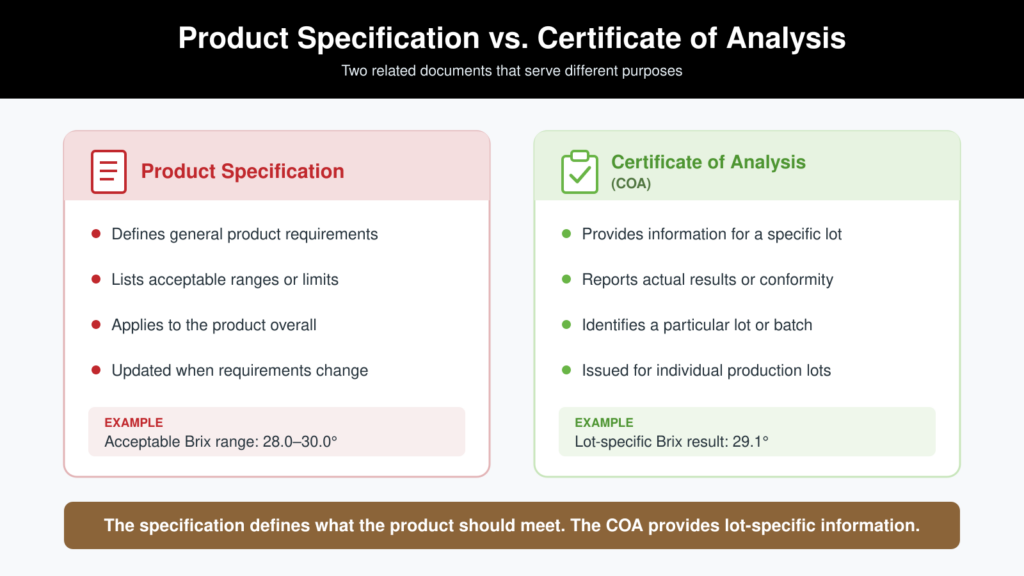
A specification defines the product’s acceptable requirements, while a COA provides information for a particular production lot.
A product specification and a certificate of analysis serve different purposes.
The specification establishes the general requirements or acceptable limits for the product. It describes what compliant product is expected to be.
A certificate of analysis, commonly called a COA, is associated with a particular lot or batch. It may list actual test results for that lot, report whether certain requirements were met, or provide a combination of numerical results and pass-or-conform statements.
For example, a specification might establish an acceptable Brix range of 28.0 to 30.0 degrees. The COA for a particular lot might report an actual result of 29.1 degrees.
Not every item on a specification is necessarily tested and reported numerically on every COA. Some attributes may be monitored through process controls, periodic testing, supplier programs, or other verification activities. COA formats and testing frequencies vary by supplier and product.
Customers should review both documents and understand which parameters are tested per lot, which are reported by conformity, and which are controlled through other parts of the processor’s quality system.
The specification tells you what the product should meet. The COA provides lot-specific information about the product being shipped.
Use the Specification as a Starting Point
A fruit ingredient specification sheet provides important technical information, but it does not answer every commercial or application question.
It may not show current inventory, lead time, freight cost, sample availability, minimum order quantity, crop conditions, or how the ingredient will perform in a particular formula. It also cannot fully communicate the color, flavor, aroma, or texture of the product.
That is why specification review, documentation review, sample evaluation, and commercial planning should work together.
At Encore Fruit, we help customers review fruit ingredient options, coordinate specifications and supporting documents, request samples, and communicate technical questions with our processing partners.
If you are reviewing a fruit ingredient specification and something is unclear, reach out to our team. You don’t need to interpret every line on your own.
We are always happy to help explain what the information means and determine whether the product may be a good fit for your application!